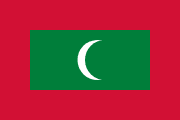
Maldives
- Capital:
- Male
- Continent:
- Asia
- Region(s):
- Southern Asia, South Central Asia
- Abbreviation:
- MDV
531,517
As of Jan 1, 2026 - Source
531,517
As of Jan 1, 2026 - Source
Maldivess' population is projected to be479,394 by 2097.
Historical
Switch the toggle to see projected data.
Year↓ | Population | Change | Pop. Rank |
|---|---|---|---|
| 2026 | 531,517 | 0.59% | 174 |
| 2025 | 529,676 | 1.07% | 174 |
| 2020 | 502,118 | 2.95% | 175 |
| 2019 | 487,731 | 3.09% | 175 |
| 2018 | 473,099 | 3.23% | 175 |
| 2017 | 458,287 | 3.38% | 175 |
| 2015 | 428,154 | 3.48% | 175 |
| 2010 | 360,792 | 3.32% | 179 |
| 2005 | 306,429 | 1.67% | 179 |
| 2000 | 282,019 | 1.9% | 178 |
Year↑ | Population | Change | Pop. Rank |
|---|---|---|---|
| 2026 | 531,517 | 0.59% | 174 |
| 2032 | 544,283 | 0.4% | 174 |
| 2037 | 556,633 | 0.45% | 173 |
| 2042 | 570,378 | 0.49% | 172 |
| 2047 | 583,392 | 0.45% | 173 |
| 2052 | 593,069 | 0.33% | 173 |
| 2057 | 596,761 | 0.12% | 173 |
| 2062 | 593,633 | -0.1% | 174 |
| 2067 | 583,830 | -0.33% | 173 |
| 2072 | 568,386 | -0.53% | 174 |
15.3K
77.9K
155.9K
249.1K
Male has a metropolitan area population of 249,059, comprising 46.86%% of Maldives' total population.
Rank | City | 2026 Pop.↓ | % of National Pop. |
|---|---|---|---|
| 1 | Male | 249,059 | 46.86% |
| 2 | Hulhumale | 80,275 | 15.1% |
| 3 | Hithadhoo | 15,275 | 2.87% |
| 4 | Kulhudhuffushi | 11,297 | 2.13% |
| 5 | Fuvahmulah | 9,513 | 1.79% |
| 6 | Feydhoo - Maradhoo | 7,410 | 1.39% |
| 7 | Thinadhoo | 6,804 | 1.28% |
| 8 | Vilimale | 6,211 | 1.17% |
| 9 | Gan | 5,851 | 1.1% |
| 10 | Maafushi | 5,486 | 1.03% |
As of 2026, Maldives has a total population of 531,517, ranking as the 174th most populous nation in the world.
Maldives has a net population change of approximately 4 people per day, driven by 14 births, 4 deaths, and net emigration of 6 people.
Maldives represents < 0.01% of the total global population and 0.01% of Asia's population.
Maldives has a population density of 1771.7 people per km² (approximately 4588.7 per mi²), making it the 7th most densely populated country in the world.
Currently, 88.25% of the population resides in urban areas, a figure that is increasing annually.
*Rates last updated: September 25, 2026
As of 2026, the largest ethnicity in Maldives is homogeneous mixture of Sinhalese, Dravidian, Arab, Australasian, and African resulting from historical changes in regional hegemony over marine trade routes.
As of 2026, Sunni Muslim (official) is the largest religion in Maldives, comprising 100% of the population.