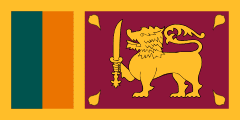
Sri Lanka
- Capital:
- Colombo
- Continent:
- Asia
- Region(s):
- Southern Asia, South Central Asia
- Largest Cities:
- Colombo, Kaduwela (Battaramulla), Maharagama
- Abbreviation:
- LKA
23,348,315
As of Jan 1, 2026 - Source
23,348,315
As of Jan 1, 2026 - Source
Sri Lanka's population is projected to be21,607,571 by 2097.
Historical
Switch the toggle to see projected data.
Year↓ | Population | Change | Pop. Rank |
|---|---|---|---|
| 2026 | 23,348,315 | 0.56% | 60 |
| 2025 | 23,229,470 | 0.58% | 60 |
| 2020 | 22,561,807 | 0.68% | 58 |
| 2019 | 22,410,552 | 0.71% | 58 |
| 2018 | 22,253,118 | 0.75% | 57 |
| 2017 | 22,087,522 | 0.81% | 57 |
| 2015 | 21,729,971 | 0.8% | 57 |
| 2010 | 20,879,089 | 0.65% | 57 |
| 2005 | 20,216,524 | 0.94% | 54 |
| 2000 | 19,293,054 | 1.9% | 51 |
Year↑ | Population | Change | Pop. Rank |
|---|---|---|---|
| 2026 | 23,348,315 | 0.56% | 60 |
| 2032 | 23,951,250 | 0.41% | 64 |
| 2037 | 24,339,994 | 0.32% | 65 |
| 2042 | 24,625,365 | 0.23% | 66 |
| 2047 | 24,786,708 | 0.13% | 67 |
| 2052 | 24,812,222 | 0.02% | 70 |
| 2057 | 24,744,905 | -0.05% | 71 |
| 2062 | 24,588,826 | -0.13% | 71 |
| 2067 | 24,343,068 | -0.2% | 71 |
| 2072 | 24,046,768 | -0.24% | 70 |
86K
100K
250K
Colombo has a metropolitan area population of 468,377, comprising 2.01%% of Sri Lanka's total population.
Rank | City | 2026 Pop.↓ | % of National Pop. |
|---|---|---|---|
| 1 | Colombo | 468,377 | 2.01% |
| 2 | Kaduwela (Battaramulla) | 319,383 | 1.37% |
| 3 | Maharagama | 211,706 | 0.91% |
| 4 | Negombo | 174,048 | 0.75% |
| 5 | Moratuwa | 157,164 | 0.67% |
| 6 | Dehiwala-Mount Lavinia | 155,896 | 0.67% |
| 7 | Kalmunai (incl. Sainthamarathu) | 107,090 | 0.46% |
| 8 | Sri Jayawardenepura | 98,062 | 0.42% |
| 9 | Batticaloa | 94,388 | 0.4% |
| 10 | Kandy | 86,895 | 0.37% |
As of 2026, Sri Lanka has a total population of 23,348,315, ranking as the 60th most populous nation in the world.
Sri Lanka has a net population change of approximately 318 people per day, driven by 866 births, 464 deaths, and net emigration of 84 people.
Sri Lanka represents 0.29% of the total global population and 0.47% of Asia's population.
Sri Lanka has a population density of 372.3 people per km² (approximately 964.3 per mi²), making it the 34th most densely populated country in the world.
Currently, 13.89% of the population resides in urban areas, a figure that is increasing annually.
*Rates last updated: September 25, 2026
As of 2026, the largest ethnicity in Sri Lanka is Sinhalese (74.9%), followed by Sri Lankan Tamil (11.2%).
As of 2026, Buddhist (official) is the largest religion in Sri Lanka, comprising 70.2% of the population.