World Superpowers 2026

0
10
20
30
40
50
60
70
80
90
100


- As of now, only the United States meets the standards to be classified as a superpower. However, this classification has faced scrutiny in recent times. Presently, academic discussions have identified China, the European Union, India, and Russia as potential contenders for achieving superpower status.
- US News power rankings are compiled from each country’s scores in six attributes related to national power: leadership, economic influence, strength of exports, political influence, the strength of international alliances, and strength of military.
World superpowers, also called global superpowers, are the world’s most powerful nations. Superpowers assume dominant positions on the world stage and are characterized by their ability to exert influence or project power (or aid) on a global scale. The economic, military, and foreign policies of superpowers are watched closely by other countries and can greatly impact the rest of the world. Britannica insightfully defines a superpower as “a state that cannot be ignored on the world stage and without whose cooperation no world problem can be solved.”
Countries Deemed Superpowers in 2023
- United States
- China
- Russia
- Germany
- United Kingdom
The term “global superpowers” first appeared after World War II and was applied to the United States and the Soviet Union. The U.S. and the U.S.S.R. dominated world affairs during the Cold War, and neither made a move without considering the reaction of the other (hence Britannica’s reference to cooperation). Some experts argue that only the U.S. remained a superpower after the Soviet Union dissolved/downsized to become Russia in the early 1990s. Today, opinions differ as to whether the U.S. remains the only global superpower or whether it is one of a small, select group of superpowers.
1. The United States
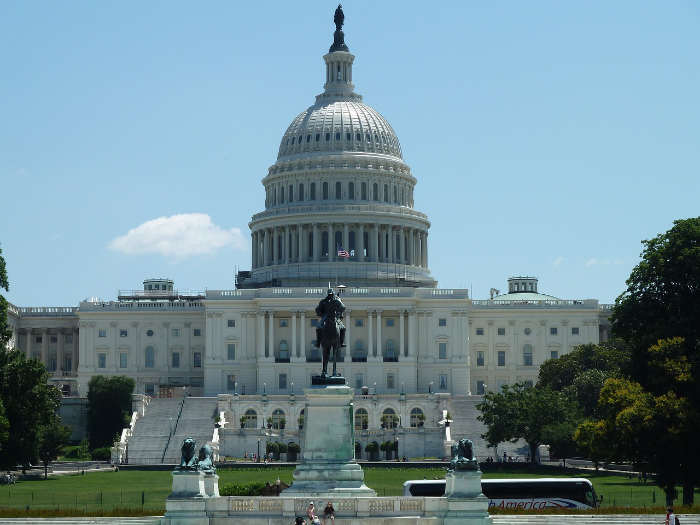
The United States is the one country today whose global superpower status is undisputed. In fact, some experts argue that the U.S. is currently the world’s only true superpower. The U.S. is the world’s most dominant military and economic power, with a military budget of US$778 billion as of 2020 and a Gross Domestic Product (GDP) of US$28.78 trillion as of 2024. The United States spends more on defense than the next nine highest-spending countries (China, India, Russia, the U.K., Saudi Arabia, Germany, France, Japan, and South Korea) combined.
The U.S. also has strong economic growth capacity. According to Tufts University political scientist Michael Beckley, long-term economic growth depends upon a country’s geography, demography (people), and political institutions, and the United States is better positioned than competing powers in all three categories, being “big (geographically), young, and highly educated” with a healthier government than competing superpowers.
Given its strengths, some experts argue that the United States’ greatest vulnerability is possible decay from within, particularly given the current highly divided political climate. An example of this division is the Presidency of Donald Trump, whose actions on immigration, foreign policy, trade, and military strategy were often viewed as less cooperative than those of previous administrations, and garnered significant attention—and often criticism—even from the United States’ closest allies. Some of the most impactful moves made during Trump’s tenure included withdrawing from the Trans-Pacific Partnership, banning citizens of several Muslim-majority countries from entering the U.S., leaving the Paris climate accord, and conducting military actions including a January 2020 drone strike on Iran.
Trump’s successor, President Joe Biden, has walked back many of Trump’s foreign policy changes and decisions. For instance, Biden lifted the “Muslim ban,” canceled Trump’s planned withdrawal from the World Health Organization, and rejoined the Paris climate accord in 2021.
2. China
China is considered an emerging superpower or a potential superpower. Some experts argue that China will pass the United States as a global superpower in the coming decades. China’s 2020 GDP was US$14.7 trillion, the second-highest in the world. It is also the most populous country in the world. While China’s defense spending is significantly lower than that of the United States at $252 billion, it is still the second-highest in the world. Additionally, China continues to gain ground on the world stage: increasing its diplomatic reach, rising to become one of the largest contributors to the global economy, and pushing technological advances—especially in artificial intelligence (AI) and green technology.
That said, China must overcome some significant hurdles in its path. Its population is large but rapidly aging and highly undereducated, with more than 2/3 of its workers lacking a high-school education. The sheer number of Chinese citizens puts a constant strain on the country’s resources, and pollution and malnutrition are ongoing concerns. The Chinese government is also often cited as a hindrance to growth due to its deep corruption and willingness to sacrifice economic growth and the personal advancement of its citizens in order to maintain control.
3. Russia
Whether Russia is a global superpower in today’s world is a matter of some debate, but there is no doubt that its predecessor, the Soviet Union, was absolutely a superpower. Russia is the world’s largest country by landmass, covering most of northern Asia and Eastern Europe and sharing borders with more than a dozen neighboring countries. Russia is also one of the world’s leading suppliers of oil, natural gas, and wheat. However, modern Russia is not the same global powerhouse it once was. Its 2020 GDP was only US$1.4 trillion, roughly 10% of China’s and less than 7% of the United States GDP. Russia’s population is about 145.8 million people but is expected to decrease by as much as 30% over the next 30 years.
World leaders, scholars, and journalists often disagree about whether Russia is currently a proven or potential superpower. The late Venezuelan President, Hugo Chavez, stated in 2009 that Russia is a superpower, citing the waning influence of the U.S. in global affairs. But Matthew Fleischer of the Los Angeles Times argued in 2014 that Russia would only become a superpower if the climate change that is melting the permafrost that currently covers about two-thirds of the country reveals plentiful stores of natural gas, oil, and precious minerals, enabling Russia to control the world’s supply of these resources.
Others argue that Russia is not even a potential superpower because it has the trade relations of a Third World country, a much smaller GDP than China or the United States, and no highly rated universities, among other things. Russia is also among the poorest countries in Europe, with a GDP per capita significantly below the European average though still higher than several Eastern and Southeastern European nations such as Ukraine, Moldova, and Kosovo.
4. Germany
Germany may not always make headlines with bold declarations, but it quietly stands as one of the most powerful and influential countries in the world. With a $4.1 trillion economy as of 2022, it’s the largest in Europe and fourth-largest globally. Germany’s strength lies in its world-renowned engineering, strong export economy, and steady leadership within the European Union. From high-end cars to green technology, the country plays a key role in shaping global markets and policies.
In recent years, Germany has begun to step up on the global stage in new ways. In 2022, the government committed to a major boost in defense spending—including a €100 billion modernization fund—and signaled its intent to meet NATO’s 2% target, a notable shift for a country known for its post-WWII military restraint. While some wonder whether demographic challenges or cautious politics might limit its rise, many see Germany as a thoughtful, values-driven power with growing global influence. Quietly but confidently, it’s carving out a stronger role in the international arena.
5. United Kingdom
The United Kingdom may be an island nation, but its influence stretches far beyond its shores. With the sixth-largest economy in the world as of 2022, the UK is a major player in finance, technology, and culture. London remains a global financial capital, and the country’s music, media, and universities shape ideas and trends worldwide.
Even after Brexit, the UK continues to play a big role on the world stage—thanks to its strong military, diplomatic reach, and leadership in science and innovation. Whether through its global alliances, cultural footprint, or steady presence in international affairs, the UK still stands as one of the most recognized and influential powers in the world.
Superpowers of the Future
The global balance of power is constantly shifting, and at least some of today’s superpowers will eventually fade as time and change erode their power. When this happens, which countries are most likely to take their place? Management consulting firm Pricewaterhouse Coopers predicts that not only India but also Brazil, Mexico, and Nigeria will emerge as superpowers by the year 2050.
Sources
- Power - US News
- Potential superpower - Wiki
- Superpower - Britannica
- What Are Global Superpowers? - World Atlas
- China Seen Overtaking U.S. as Global Superpower - Pew Research
- Why the United States Is the Only Superpower - Tufts University
- The World in 2050 - Pricewaterhouse Coopers
- Five superpowers ruling the world in 2050 - BBC